
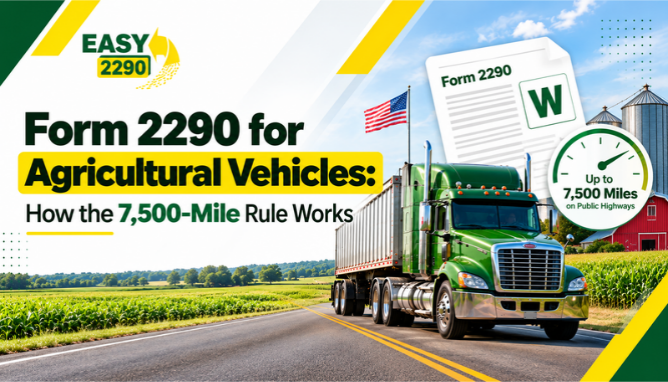
A farm truck can be quiet for weeks and then suddenly spend every day on the road during harvest.
That is normal. Agricultural trucks are often used in bursts rather than driven every day like regular commercial vehicles. Because of that, the IRS gives qualifying agricultural vehicles a higher mileage limit under Form 2290.
For most suspended vehicles, the limit is 5,000 miles.
For qualifying agricultural vehicles, it is 7,500 miles on public highways during the tax period.
If the truck stays within that limit, the Heavy Vehicle Use Tax can generally remain suspended.
Which Farm Trucks Qualify?
Not every truck owned by a farm automatically gets the 7,500-mile limit.
The truck usually needs to be used mainly for farming and registered under state law as an agricultural vehicle.
That may include trucks used for:
- crops;
- livestock;
- feed;
- fertilizer;
- seed; or
- farm machinery.
A truck doing mostly general commercial hauling may not fit the rule, even if the owner also operates a farm.
The full IRS definition is available in the Form 2290 instructions.
5,000 Miles or 7,500 Miles?
The difference is easy to remember.
| Vehicle | Mileage Limit |
| Regular suspended vehicle | 5,000 miles |
| Agricultural vehicle | 7,500 miles |
The mileage that matters here is public-highway mileage.
That can be important for farm vehicles because plenty of driving may happen on private land.
For example, a truck may show 8,000 total miles on the odometer, but only 6,500 of those were on public roads. In that case, the public-highway figure is the number that matters for this rule.
You Still Need to File Form 2290
The word “suspended” sometimes causes confusion.
It does not mean you can leave the truck off the return.
The vehicle still needs to be reported on Form 2290, usually as Category W.
If you want more detail on that part, Easy2290 already explains suspended vehicles and Category W.
What If the Truck Goes Over 7,500 Miles?
This is where keeping an eye on the mileage helps.
Say the truck is sitting at 6,700 public-highway miles in September. Harvest gets busy, deliveries increase, and by October it reaches 7,650 miles.
Once it goes over the limit, the suspension generally ends and HVUT becomes due.
The filing deadline is normally based on the month the mileage limit was exceeded.
If that happened in October, the Form 2290 filing would generally be due by the end of November, subject to weekends and federal holidays.
Keep the Mileage Record Simple
You do not need a complicated tracking system.
For most farms, a basic record with these details is enough:
- date;
- odometer reading;
- destination;
- public-road miles; and
- reason for the trip.
That makes it much easier to see whether the truck is getting close to the limit.
It is especially useful when the vehicle switches between private farm roads and public highways during the same week.
Already Paid HVUT?
Sometimes the opposite happens.
You expect the truck to go over 7,500 miles, pay the tax, and later find that the vehicle stayed below the limit.
Depending on the situation, a credit may be available.
If that happens, check the IRS rules before making a claim. You can also review the filing options on the Easy2290 forms page.
Before You File
Have the basic vehicle details ready:
- EIN
- VIN
- Taxable gross weight
- First-use month
- Agricultural registration details
- Expected highway mileage
It is worth copying the VIN directly from the registration rather than typing it from memory. One wrong character can create a correction later.
Filing an Agricultural Vehicle With Easy2290
You can use Easy2290 to prepare and e-file Form 2290 for taxable and suspended vehicles.
If your farm truck qualifies for the agricultural mileage rule and stays within 7,500 public-highway miles, you may be able to keep the tax suspended.
The important part is not complicated: report the vehicle correctly and keep a reasonable mileage record during the year.
That becomes much easier than trying to work everything out after harvest is over.
FAQs
How many miles can an agricultural truck travel under Form 2290?
A qualifying agricultural vehicle can generally travel up to 7,500 miles on public highways during the tax period and remain suspended.
Does the truck still need to be reported?
Yes. Suspended agricultural vehicles still need to be included on Form 2290.
Do private farm miles count?
The mileage limit is based on public-highway use, so driving only on private property is treated differently.
What happens after 7,500 miles?
The suspension generally ends and HVUT becomes due.
Ready to file your Form 2290?
Create a free account today and complete your electronic filing in under 5 minutes.
Start Filing Now